


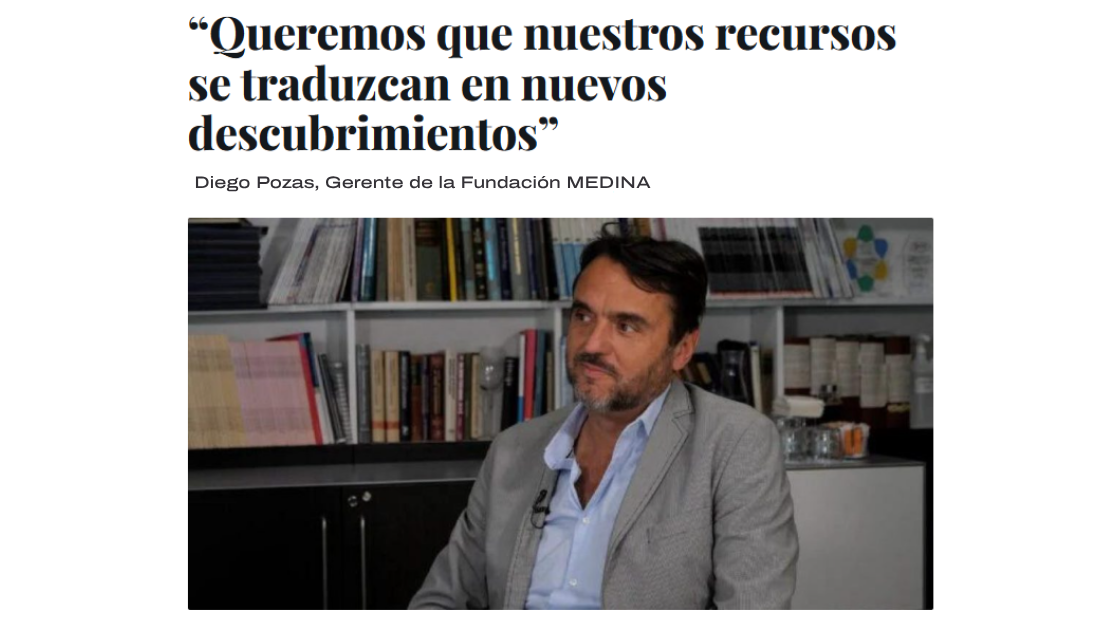
Diego Pozas in Tribuna de Andalucía: Science as a strategic investment for Andalusia
In an interview with Tribuna de Andalucía, the Managing Director of Fundación MEDINA discusses the value of its microbial culture collection, its applications across industrial sectors, and the conditions research in Spain and Andalusia needs in order to translate into real impact.
Granada, August 21, 2026
Competitive and stable funding, career paths capable of attracting and retaining talent, and an environment that enables collaboration and knowledge transfer. These are the three elements that science needs to generate sustained impact, according to Diego Pozas. The Managing Director of Fundación MEDINA sets them out in an interview published by Tribuna de Andalucía, in which he also points to the opportunity to consolidate competitive scientific and biotechnology hubs in Andalusia by building on infrastructure such as Granada’s Health Technology Park (Parque Tecnológico de la Salud). “Research needs continuity,” he cautions: taking a discovery from an initial idea to an application requires years of work and the capacity to take on scientific risk.
In MEDINA’s case, that continuity has a tangible expression: a collection of 190,000 microbial strains spanning a wide geographical, ecological and taxonomic diversity, complemented by extensive natural product libraries. As Pozas explains in the interview, the value lies not only in preserving that biodiversity, but in combining it with an integrated discovery platform that can turn a preserved strain into the starting point for a new antibiotic, a drug candidate, an enzyme or a biotechnological solution.
MEDINA makes its scientific and technological capabilities available to companies and research groups in pharma, cosmetics, agrifood and biotechnology. The same platform the Foundation uses to discover drugs is applied to the needs of other sectors: identifying a strain or extract with an activity of interest, discovering a bioactive compound, developing assays to validate its effect, or chemically characterising new molecules.
“Investing in science means investing in our ability to respond to the problems of the future,” says Pozas.